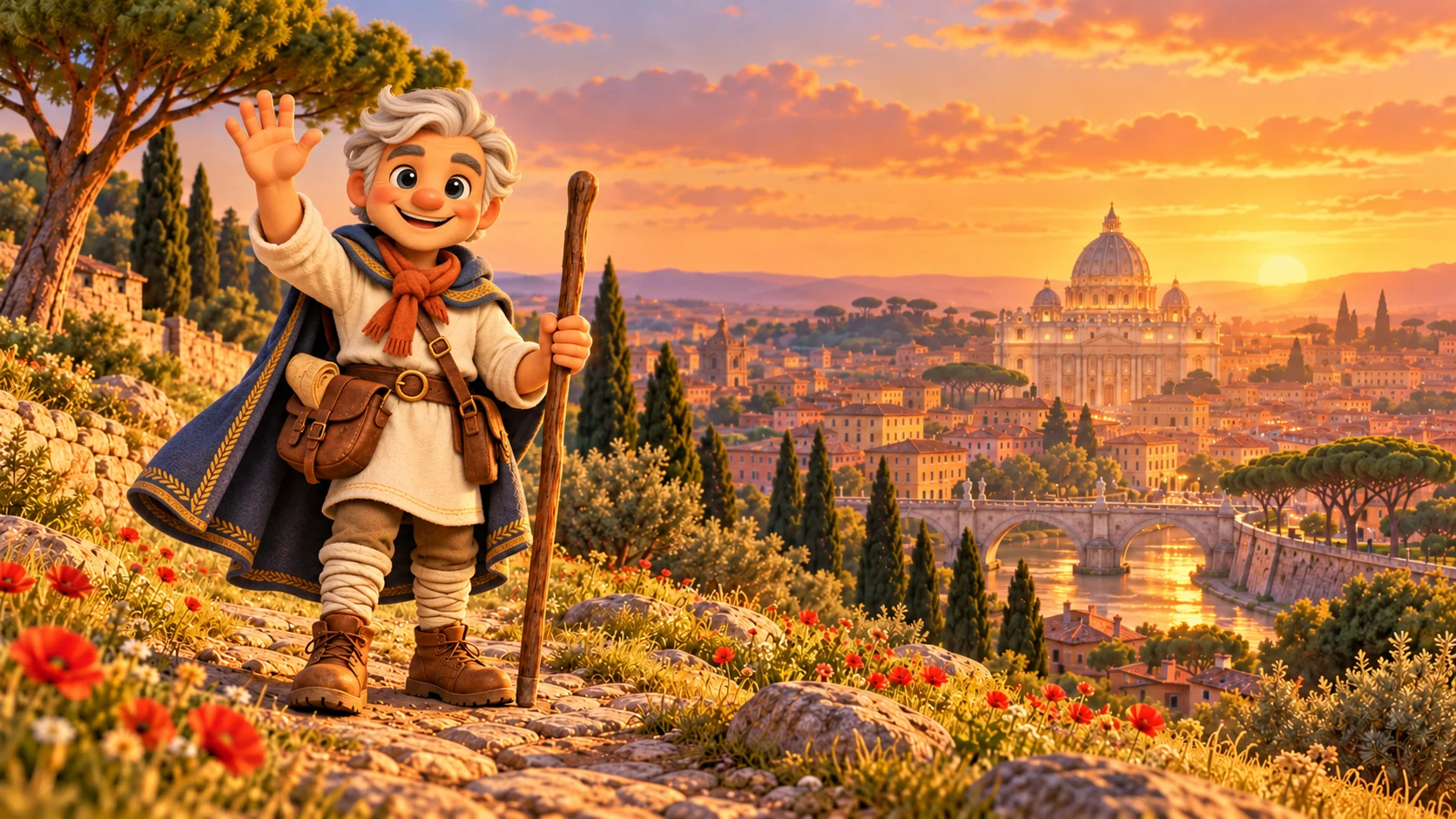
Dear walker,Sacred Steps: Road to Rome is out. It is our fifth app and our third pilgrimage. Your daily steps now carry you along the Via Francigena, the old pilgrim road from Canterbury Cathedral to St Peter’s in Rome: 2,202 kilometres on foot, in 71 stages, across England, France, Switzerland and Italy.
If you have walked with us before, you know how it works. Apple Health hands the app your step count. The app turns it into distance and moves you along the road. There is nothing to log, no workout to start, and no GPS following you. You walk your own streets, and the road to Rome passes under your feet.
The Temple Path goes round an island, and the Camino runs west to the sea. This road does something neither of them does. It crosses a continent, through four countries and over the Alps on foot. We want to spend this letter on that road, and on the man who first wrote it down.
A list written in 990
In 990 Sigeric, the new Archbishop of Canterbury, travelled to Rome to receive the pallium, the band of white wool that the Pope gives to an archbishop. On the way home, someone in his party wrote down where they stopped: some eighty places, numbered from Rome northwards to the Channel. It is little more than a list of names. It is also the oldest surviving record of the road, and the reason the Via Francigena follows the line it does today.
Sigeric is your guide in the app. He was known as Sigeric the Serious, and we have let him keep a little of that. He meets you in Canterbury, walks beside you stage by stage, and says a few words when you arrive somewhere that mattered to him.
What the road crosses
The app divides the route into 71 stages, each a day’s walk between real towns. Every stage carries the history of the ground it covers, checked against primary sources, and the stages fall into regions where you can feel the land change.
Beginning at the cathedral
The road begins in Canterbury Cathedral, where Thomas Becket was killed in 1170 and where pilgrims have come ever since. A day’s walk brings you to Dover and the white cliffs. The Channel is crossed by ferry, as it always has been, and the crossing is not counted as walking.
Canterbury Cathedral · Dover · the white cliffs
Chalk, wheat and the city of coronations
In France the road crosses the open chalk country of Artois and Picardy: wheat fields broken by church spires and, near the Somme, by the quiet cemeteries of the First World War. It comes to Reims, whose cathedral saw the crowning of French kings for centuries, and turns south through the vineyards of Champagne.
Wissant · Arras · Laon · Reims Cathedral
Into the hills
South of Champagne the land begins to climb, past Langres on its ramparts and through Besançon, the old city of clockmakers, then up into the forests of the Jura, where the road crosses into Switzerland beyond Pontarlier.
Langres · Besançon · Pontarlier
Lakes, vineyards and the pass
In Switzerland the road comes down to Lake Geneva at Lausanne, runs along the terraced vineyards of Lavaux and past the castle of Chillon, and enters the Rhône valley at Saint-Maurice, where an abbey has stood since 515. Then it climbs to the Great St Bernard Pass, 2,469 metres up. The hospice there was founded around 1050, and it still opens its door to travellers every day of the year.
Lausanne · Lavaux · Saint-Maurice · the Great St Bernard Hospice
Down into Italy
Over the pass you are in Italy, walking down the Aosta Valley past Roman gates and castles. Then the mountains open onto the wide, flat plain of the Po: the rice fields of Vercelli, where a book of Old English poems has been kept for nearly a thousand years; the tomb of St Augustine at Pavia; and a ferry across the Po itself.
Aosta · Ivrea · Vercelli · Pavia · Piacenza
Over the Cisa, towards Siena
The road climbs once more, over the Cisa Pass in the Apennines, and comes down into Tuscany: the walls of Lucca, the towers of San Gimignano, the Campo in Siena, and the bare clay hills and hot springs of the Val d’Orcia.
The Cisa Pass · Lucca · San Gimignano · Siena · Radicofani
The last roads to Rome
In the last stages you walk past Lake Bolsena, through Viterbo, the city of the popes, and along the old Via Cassia until Rome comes into view. The road ends where Sigeric’s list begins, at St Peter’s, where anyone who has walked the last 100 kilometres can ask for the Testimonium, the certificate of their pilgrimage.
Bolsena · Viterbo · Sutri · St Peter’s Basilica
The pilgrim credential
Real pilgrims carry a credential, a folded card stamped at churches and hostels along the way. Yours holds 72 stamps: one for Canterbury, and one for every town where a stage ends, all the way to St Peter’s. A stamp is earned only when you arrive. You cannot skip ahead to Siena.

Along the way you meet seventy people of the road, each with a story of their own: a fisherman at Wissant, a champagne grower, a canon of the Great St Bernard, a ferryman on the Po, a canon of St Peter’s. Fifty-two illustrated patches mark your progress, from your first steps to the end of the road.
Chaucer knew why
The most famous pilgrims in English literature never went further than Canterbury. Chaucer’s storytellers set out from London for Becket’s shrine, and in the first lines of his book he gives the reason people take to the road at all:
Thanne longen folk to goon on pilgrimages,
And palmeres for to seken straunge strondes.
“Then people long to go on pilgrimages, and palmers to seek foreign shores.”
Geoffrey Chaucer, The Canterbury Tales, General Prologue, c. 1390
Road to Rome starts where they stopped. Alongside Sigeric, the app carries a reading for every day of the year, from St Augustine and Petrarch to the pilgrims who wrote down what they saw, and a Pilgrim’s Notebook of nine illustrated chapters, from “Where the Pilgrim Road Begins” to “The Last Roads to Rome”, for the days you want more than a paragraph.
What is in the app
Choose who walks: Sigeric himself, a hospitaller, a fresco painter, an alpine guide, even a St Bernard dog, among more than forty characters. There is a full Apple Watch app, widgets and Live Activities, and you can start a walking group with friends and see each other on the map. The app comes in eight languages, with distances in kilometres or miles.
What is not there: no account, no ads, no subscription and no in-app purchases. Your health data is read on your device and stays there, or goes into your own private iCloud, and never comes to us. If you join a walking group, its members see your display name, avatar or photo, progress, badges and messages, and nothing else.
Why we made this one
Most of us will never walk to Rome. It takes about three months on foot. But the Via Francigena was never only for the ones who finished. For a thousand years people walked whatever part of it they could, turned back when they had to, and it still counted.
A road like that can be walked a few thousand steps at a time, from wherever you are, over as many months as you like.
Start at the cathedral. Dover is first.
With thanks to the associations and volunteers who keep the Via Francigena waymarked and its hostels open — — The Lost Theory team
Walk to Rome
Sacred Steps: Road to Rome is available now on the App Store for iPhone & Apple Watch.
Download on the App Store →